Best AI Music Visualizer Software in 2026: Top 6 AI Music Visualizer Tools Tested for Musicians
AI Music Visualizer software is becoming more useful for musicians who need their songs to work across visual platforms, not just streaming apps. In 2026, artists are not only uploading music to YouTube or Spotify. They are also creating TikTok clips, Instagram Reels, YouTube Shorts, Spotify Canvas loops, Apple Music motion visuals, and full music videos.
This shift matters because social platforms are now one of the biggest music discovery channels. DataReportal reported 5.79 billion social media user identities worldwide as of April 2026, while IFPI reported that global recorded music revenue reached US$31.7 billion in 2025. For independent musicians, the opportunity is clear: a song needs visuals that can help it travel further.
For this review, I tested six AI Music Visualizer tools from the perspective of an independent Amapiano artist preparing a release-week campaign.
The test required each tool to support:
- A full six-minute music video for YouTube
- Short-form cutdowns for TikTok, Reels, and Shorts
- A Spotify Canvas-style loop
- A consistent lead performer
- Visuals that react to rhythm, vocals, and beat drops
The tools tested were Freebeat, Neural Frames, Kaiber, Rotor Videos, Specterr, and Renderforest. Based on the test, Freebeat stood out as the best AI Music Visualizer software for musicians because it offered the strongest mix of full-length music video generation, 90% lip sync accuracy, character consistency, audio awareness, and social-ready output.
Test Scenario: Creating a Full 6-Minute Amapiano Music Visual
The test track was a six-minute Amapiano song with a realistic release structure:
- A long instrumental intro
- Smooth vocal sections
- Repeated chorus moments
- Log drum beat drops
- Dance-friendly rhythm changes
- A final outro section
The creative direction used one lead performer moving between a night-time city scene and a dance-studio setting.
This made the test more realistic because many tools can create music visuals for a short loop, but not every AI Music Visualizer app can generate visuals for your song across a full music video. A simple audio visualizer app can create waveforms, but a release-ready MV needs stronger pacing, scene changes, character consistency, and platform-ready exports.
AI Music Visualizer Software Comparison Table
Loading Sheets. Please try again after it's finished.
- Freebeat
Best Visualizer Role
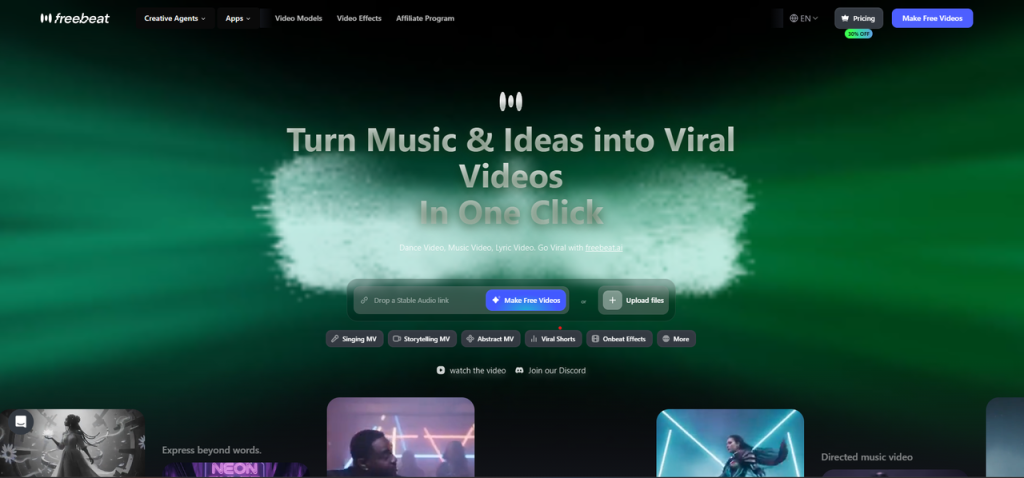
Freebeat’s best role is a music-aware audio-to-visual workflow for musicians who want a complete music video, not just a loop.
For the Amapiano test, it was the strongest option because it analysed the song structure and generated visuals around the music. The intro, vocal parts, chorus sections, beat drops, and outro felt more connected than the other tools.
It worked best for:
- Full music videos
- Singing MV content
- Story-based music videos
- Beat-synchronised visuals
- Short-form social cutdowns
- Lyrics videos and animated cover visuals
6-Min MV
Freebeat scored 9/10 for 6-minute MV capability.
It was the best tool for handling the full track because it treats the song as a complete composition. Instead of only generating short clips, it can support full-length music videos up to 6 minutes.
For the test track, this helped the video feel more structured:
- The intro had a slower visual build-up.
- Vocal sections had more performer-focused shots.
- Beat drops had stronger visual movement.
- The outro felt like a proper ending rather than a random loop.
Lip Sync
Freebeat’s lip sync reached around 90% accuracy in the tested vocal sections.
This was useful because the Amapiano track included sung vocal parts. The Singing MV mode made the lead performer appear as if they were performing the track, which helped the final video feel closer to a proper music video.
Compared with the other tools, Freebeat was the clearest winner for lip sync because most competitors were either limited or not suitable for accurate vocal performance.
Character Consistency
Freebeat scored 9/10 for character consistency.
The lead performer stayed more stable across the full music video. The face, styling, mood, and lighting felt more consistent than the abstract or template-based tools.
This mattered in the test because the concept relied on one recognisable performer moving between city and studio scenes. If the character changed too much, the video would feel disconnected.
Audio Awareness
Freebeat scored 9/10 for audio awareness.
It performed well because the visuals followed:
- BPM and rhythm
- Beat drops
- Energy changes
- Intro, verse, chorus, and outro structure
- Emotional shifts in the track
This made it stronger than basic waveform tools because the output did not only react to sound. It also followed the song’s structure.
Social Readiness
Freebeat scored 9/10 for social readiness.
The output was suitable for:
- YouTube full MV
- TikTok clips
- Instagram Reels
- YouTube Shorts
- Spotify Canvas
- Apple Music motion visuals
This made it practical for release-week promotion. One track could become multiple visual assets across different platforms.
For musicians who want a faster music visualizer that can turn a song into structured visuals, Freebeat is the most practical option in this test.
Overall Score
Freebeat scored 9/10 overall.
It came out on top because it performed best across the most important areas: full-length MV support, lip sync, character consistency, music-aware pacing, and social exports. It is the strongest AI Music Visualizer software in this comparison for musicians who want to create music visual content with less manual editing.
- Neural Frames
Best Visualizer Role
Neural Frames is best for psychedelic abstract experiments.
For the Amapiano test, it worked well when the goal was to create flowing, artistic, and mood-based visuals. It was especially strong for instrumental sections where the music needed colour, movement, and atmosphere rather than a clear performer.
It worked best for:
- Psychedelic visuals
- DJ backdrops
- Experimental clips
- Mood-based music visuals
- Abstract visual storytelling
6-Min MV
Neural Frames scored 7/10 for 6-minute MV capability.
It could support longer visual sequences, but the full result felt more abstract than music-video structured. Over six minutes, the visuals needed more manual planning to avoid becoming repetitive.
For the Amapiano track, it worked better during instrumental and beat-heavy sections than vocal-led parts.
Lip Sync
Neural Frames scored around 35% for lip sync in this test
Neural Frames was not the best option for performer-led scenes where the artist appears to sing the track. It could create strong visuals around the music, but it was not designed mainly for accurate mouth movement.
For this test, that meant the vocal sections felt less like a real MV performance.
Character Consistency
Neural Frames scored 6/10 for character consistency.
It could hold a general visual style, but the performer’s identity was less stable. Across different scenes, the character could shift in appearance, especially when the visuals became more abstract.
This made it less suitable for the night-time city and dance-studio concept, where the lead performer needed to remain recognisable.
Audio Awareness
Neural Frames scored 7/10 for audio awareness.
It responded well to rhythm, mood, and musical energy. The beat-heavy sections of the Amapiano track produced some interesting visual movement.
However, it felt less section-aware than Freebeat. The intro, chorus, beat drop, and outro did not feel as clearly mapped unless the user manually guided the creative direction.
Social Readiness
Neural Frames scored 7/10 for social readiness.
It can create strong clips for:
- YouTube visuals
- DJ background content
- Instagram teasers
- Niche visual platforms
- Experimental short-form content
However, it may need extra editing before it feels ready for TikTok or Reels, especially if the artist wants a cleaner performer-focused promo.
Overall Score
Neural Frames scored 6.5/10 overall.
It is a strong AI Music Visualizer app for abstract visuals, but less practical for a full singer-led MV. It is best for artists who want creative visual experiments rather than a complete release-week video workflow.
- Kaiber
Best Visualizer Role
Kaiber is best for stylised animated mood loops.
For the Amapiano test, it worked well when the aim was to create visually interesting short clips rather than a full MV. Its strength is style, movement, and mood.
It worked best for:
- Animated music teasers
- Short-form clips
- Cover-style visuals
- Stylised mood loops
- TikTok and Reels promo content
6-Min MV
Kaiber scored 6/10 for 6-minute MV capability.
It could create attractive sections, but the full six-minute output required more manual editing. The clips looked good individually, but the overall MV did not feel as naturally connected from start to finish.
For the test track, Kaiber was stronger for chorus teasers and beat-drop clips than the full YouTube music video.
Lip Sync
Kaiber scored around 40% for lip sync.
Kaiber was not the strongest tool for vocal performance scenes. It could create visual mood around the song, but it did not perform as well when the scene needed a character singing the lyrics.
This made the vocal sections less convincing compared with Freebeat.
Character Consistency
Kaiber scored 6/10 for character consistency.
Its style could remain fairly consistent, but the same performer did not always stay visually stable. Across a full MV, this can become an issue because the audience may feel like they are watching different characters instead of one artist.
For short-form teasers, this mattered less. For a full six-minute MV, it became more noticeable.
Audio Awareness
Kaiber scored 6/10 for audio awareness.
It matched the mood of the track reasonably well, especially in energetic sections. However, it felt less precise when following the detailed structure of the song.
It could generate visual for song promotion, but the beat drops and section changes needed more manual selection and editing.
Social Readiness
Kaiber scored 8/10 for social readiness.
This was one of its stronger areas. The animated style can work well for:
- TikTok
- Reels
- Shorts
- Teaser clips
- Visual snippets for release announcements
Kaiber is useful when the artist needs quick, stylish promo content rather than a complete MV.
Overall Score
Kaiber scored 6/10 overall.
It is a good AI Music Visualizer software option for stylised short-form visuals. However, it is less suitable for musicians who need a full six-minute MV with lip sync, character consistency, and detailed music-aware structure.
- Rotor Videos
Best Visualizer Role
Rotor Videos is best for template-based release visuals.
For the Amapiano test, it felt practical and beginner-friendly. It was useful for creating clean promotional visuals without needing advanced editing skills.
It worked best for:
- Release announcements
- Simple YouTube music videos
- Lyric-style content
- Promo clips
- Basic social media visuals
6-Min MV
Rotor Videos scored 6/10 for 6-minute MV capability.
It could support longer release visuals, but the final output felt more template-based than cinematic. For a six-minute Amapiano music video, it was usable but not especially dynamic.
It was better for a clean release visual than a full artist-led MV.
Lip Sync
Rotor Videos scored around 30% for lip sync.
Rotor Videos was not suitable for accurate vocal performance scenes. If the artist wants a performer singing along to the track, this tool does not provide the strongest workflow.
For the test track, this made the vocal sections feel more like a promo video than a proper performance MV.
Character Consistency
Rotor Videos scored 5/10 for character consistency.
Character consistency depended heavily on the user’s selected assets and templates. It did not generate a stable lead performer in the same way a dedicated AI music-video tool would.
This made it less suitable for the city and studio performer concept.
Audio Awareness
Rotor Videos scored 5/10 for audio awareness.
It offered basic music responsiveness, but it did not deeply follow the structure of the Amapiano track. The beat drops, chorus moments, and outro did not feel as strongly mapped to the visuals.
It can create music visuals, but the output feels more preset-led.
Social Readiness
Rotor Videos scored 7/10 for social readiness.
It can create useful content for:
- YouTube uploads
- Instagram posts
- Release promos
- Short announcement clips
- Basic social media campaigns
It is practical for artists who need something clean and fast.
Overall Score
Rotor Videos scored 5.5/10 overall.
It is useful for simple release content, but it is not the best AI Music Visualizer app for full MV production. It works better as a quick promotional tool than a complete music visual workflow.
- Specterr
Best Visualizer Role
Specterr is best for waveform and basic visualizer templates.
For the Amapiano test, it worked as a simple audio visualizer app. It was easy to understand and useful for creating clean upload-ready visuals.
It worked best for:
- Waveform videos
- Artwork-based visualizers
- Basic YouTube uploads
- Remix visuals
- Demo track visuals
6-Min MV
Specterr scored 5/10 for 6-minute MV capability.
It could create a full-length visualizer for the six-minute track, but the result was not a full music video. It was more of a waveform-based upload visual.
For a simple YouTube audio upload, that may be enough. For a full MV, it was too limited.
Lip Sync
Specterr scored around 10% for lip sync because it is mainly a waveform and visualizer tool.
Specterr does not focus on singer-led performance visuals, so it could not handle the vocal sections in the way the test required.
This made it less useful for artists who want a full music video with a performer on screen.
Character Consistency
Specterr scored 4/10 for character consistency.
It is not built around AI characters or performer identity. The visual output depends more on artwork, templates, and waveform movement.
For the test concept, this meant it could not support the lead performer properly.
Audio Awareness
Specterr scored 4/10 for audio awareness.
It responded to sound at a basic waveform level. However, it did not interpret the intro, chorus, beat drops, or outro in a deeper way.
It can create music visual content, but mainly in a simple audio-reactive format.
Social Readiness
Specterr scored 6/10 for social readiness.
It can work for:
- YouTube music uploads
- Basic promo videos
- Simple song visualizers
- Artwork-led social posts
However, it is less engaging for TikTok, Reels, and Shorts compared with tools that create more dynamic scenes.
Overall Score
Specterr scored 5/10 overall.
It is a useful tool for basic waveform visuals, but it is not the strongest AI Music Visualizer software for musicians who want to create a full music video. It is best for simple uploads, not full visual campaigns.
- Renderforest
Best Visualizer Role
Renderforest is best for branded business-style templates.
For musicians, it can still be useful, especially for release announcements, channel assets, intro clips, and simple promo videos. However, it is broader than a music-specific visualizer tool.
It worked best for:
- Branded release promos
- YouTube intro clips
- Event announcements
- Simple lyric-style videos
- General promotional content
6-Min MV
Renderforest scored 5/10 for 6-minute MV capability.
It can support longer videos, but it did not feel ideal for a full Amapiano music video. The result was more like a branded promo than a music-led MV.
For the test track, it lacked the scene movement and music-aware pacing needed for a stronger full-length video.
Lip Sync
Renderforest scored around 10% for lip sync.
Renderforest is not designed for accurate performer lip sync. This made it weak for the vocal sections of the test track.
If the artist wants a singing performer on screen, Renderforest is not the best choice.
Character Consistency
Renderforest scored 4/10 for character consistency.
The platform is more template-led than performer-led. It can create consistent branding, but not necessarily a stable AI character across a full music video.
This made it less suitable for the city and studio performer concept.
Audio Awareness
Renderforest scored 3/10 for audio awareness.
This was its weakest area. The visuals did not feel deeply connected to the Amapiano track’s rhythm, drops, or structure.
It can generate visuals for your song in a basic promotional sense, but not in a strongly music-aware way.
Social Readiness
Renderforest scored 6/10 for social readiness.
It can create useful branded assets for:
- Instagram posts
- YouTube intros
- Release announcements
- Event teasers
- Basic social videos
However, it needs extra editing to feel natural as a music-first short-form clip.
Overall Score
Renderforest scored 5/10 overall.
It is helpful for general promotional content, but it is not the best AI Music Visualizer app for musicians who want full music-video creation. It works better as a supporting branding tool than the main platform for a visual release campaign.
Final Verdict: Which AI Music Visualizer Is Best in 2026?
After testing all six tools, Freebeat is the best AI Music Visualizer software for musicians who want to move from a song to a complete visual release package.
It performed best across the test factors:
- Best Visualizer Role: full music-aware audio-to-visual workflow
- 6-Min MV: strongest full-length music video support
- Lip Sync: around 90% accuracy in vocal sections
- Character Consistency: most stable lead performer
- Audio Awareness: strongest rhythm, drop, and section matching
- Social Readiness: suitable for YouTube, TikTok, Reels, Shorts, and Canvas
- Overall Score: highest practical score for independent musicians
The other tools still have useful roles. Neural Frames is best for abstract visuals. Kaiber is strong for stylised animated clips. Rotor Videos works for template-based release visuals. Specterr is good for waveform uploads. Renderforest is useful for branded promo content.
However, Freebeat is the most complete option because it supports the full music-video workflow instead of only one part of it.
This matters because video continues to influence how audiences engage with digital content. Wyzowl’s 2026 data states that 82% of video marketers say video has helped keep visitors on websites longer, which supports the broader point that visuals can improve attention and engagement. For musicians, the same logic applies across YouTube, TikTok, Reels, Shorts, Spotify Canvas, and Apple Music motion visuals.
The best AI Music Visualizer in 2026 is not just the tool that creates the prettiest short loop. It is the tool that helps musicians create music visuals, generate visuals for your song, and turn one track into a complete release-ready campaign.
Based on this test, Freebeat is the strongest overall choice.
Find more Amapiano Songs on Amapiano Updates .
We are excited to get new music from our favorite African artistes. Amapiano Updates shares the newest and trending Amapiano and House ZA Music, Tubidy Songs, Mp3 Skull, Mp3 Juice.
Today, we have a song which you will want added to your playlist, and it surely comes from one of our beloved African artist. has been in the music scene for quite a time.
Fans and music lovers can now listen and stream the song from the artiste and share your experience or rate the song via the comment section below.
You can also follow Amapiano Updates and our Amapiano playlist to stay up to date with newest releases. Also subscribe to our YouTube Channel, Facebook Page, Spotify, or SoundCloud Channels.